Lace Up, Stand Tall: The Real Science Behind Why Boots Change Everything

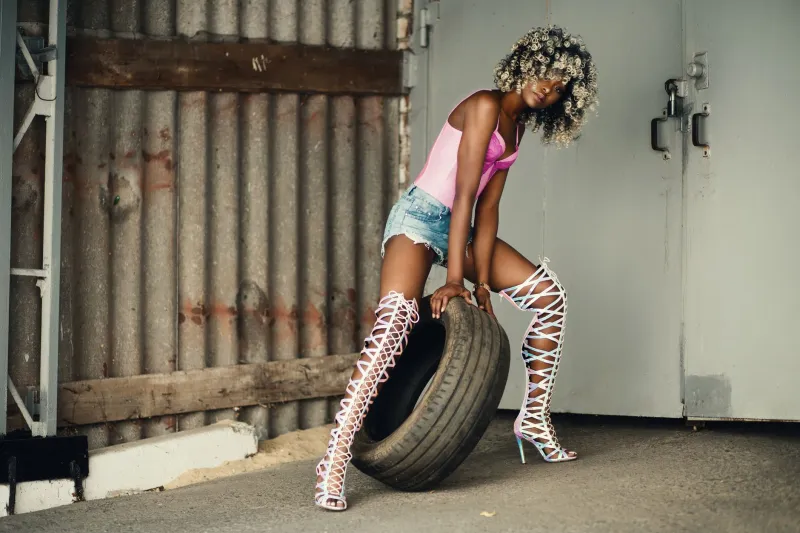
Photo: Matheus Ferrero matheusferrero, CC0, via Wikimedia Commons
You know the feeling. You pull on a pair of knee-highs — maybe that worn-in black leather pair you've had for years, or the sleek new platform pair you finally splurged on — and something shifts. Your posture adjusts. Your stride opens up. You walk into the room differently. Maybe you say the thing you'd been holding back. Maybe you finally ask for what you want.
This isn't a fluke. And it's not vanity. There's a legitimate psychological mechanism at work, and researchers have been quietly studying it for over a decade.
Enclothed Cognition: The $10 Phrase That Explains Everything
Back in 2012, social psychologists Hajo Adam and Adam Galinsky published a study that introduced a concept called enclothed cognition — the idea that the clothes we wear don't just reflect how we feel, they actively shape how we think and behave. Their experiments showed that people wearing a doctor's lab coat performed significantly better on attention-related tasks than those wearing the same coat described as a painter's smock. Same garment. Wildly different cognitive outcomes.
The key ingredients? The symbolic meaning we assign to the clothing and the physical act of wearing it. Both matter. Together, they can genuinely alter your mental state.
Boots, arguably more than almost any other garment, carry an extraordinary weight of symbolic meaning. They've been worn by soldiers, outlaws, dominatrices, cowboys, and rock stars. They have a cultural history soaked in authority, rebellion, and raw sexuality. When you put them on, you're not just covering your feet — you're borrowing from that entire legacy.
What Therapists Are Actually Seeing
Clinical therapists who work with clients around body image, self-expression, and sexuality have noticed this pattern for years, even before the research caught up.
"There's a consistent theme I hear," says one licensed therapist based in Chicago who works with adult clients exploring identity and self-expression. "People describe boots — particularly tall, structured ones — as armor. Not in a defensive, shut-down way. More like they're putting on a version of themselves they trust more. It gives them permission."
That word — permission — comes up a lot. Permission to take up space. Permission to be direct. Permission to be sexual, powerful, or simply unapologetic. For many people, the boots don't create a fake version of themselves. They help excavate a real one that's been waiting.
Another therapist, practicing in Los Angeles, frames it this way: "Footwear is the foundation of how we move through the world — literally. When someone changes what's on their feet, they change how they inhabit their body. Boots in particular add height, add weight, add sound. You hear yourself walking. That's a form of presence most people rarely let themselves have."
The Neurology of a Power Walk
Here's where it gets even more interesting. The physical properties of boots — the added height from a heel, the structured support around the ankle and calf, the weight of the sole — actually change the biomechanics of how you walk. And how you walk feeds directly back into how you feel.
Research on posture and mood shows a bidirectional relationship: your emotional state affects your posture, but your posture also affects your emotional state. Walking with a more upright, grounded stride — the kind that heeled boots naturally encourage — has been linked to increases in self-reported confidence and decreases in anxiety.
In short, the boots change your walk. Your walk changes your brain chemistry. Your brain chemistry changes your behavior. It's a loop, and boots are the on-ramp.
Real Stories: The Moments Boots Made the Difference
We asked readers to share the times their boots gave them an edge they didn't know they had. The responses were immediate, personal, and a little overwhelming.
"I wore my tall riding boots to a salary negotiation I'd been dreading for months. I'd always felt like I shrank in that conference room. That day I asked for $15,000 more than I planned to. Got it." — reader from Nashville
"I came out to my parents wearing my favorite pair of buckled leather boots. I have no idea if it mattered, but I felt like I could handle whatever they said. The boots were part of my armor." — reader from Portland
"My partner and I were going through a rough patch. I wore my boots to the conversation I'd been putting off for weeks. Something about them made me feel like I could be honest without falling apart." — reader from Philadelphia
None of these people would claim the boots did the work for them. But they all describe the same thing — a threshold effect. The boots helped them cross over from who they were being into who they needed to be.
Why This Matters Beyond Fashion
For the boots-and-fetish community specifically, this phenomenon carries an extra layer of significance. Many people in this space have spent years navigating shame, secrecy, or the dissonance between who they are in private and who they present publicly. The boots aren't just a fashion choice — they're often one of the few places where desire, identity, and self-expression collapse into a single object.
When those boots also make you feel more capable, more present, more you — that's not a small thing. That's genuinely transformative.
The science of enclothed cognition doesn't care whether your boots are a kink, a style statement, or both. It just observes what happens when people wear things that mean something to them. And what happens, consistently, is that they show up differently.
So What Do You Do With This?
The practical takeaway here isn't complicated. If there's a pair of boots sitting in your closet that makes you feel like a more complete version of yourself — wear them more. Wear them to the hard conversations, the big meetings, the first dates, the moments when you need to remember who you are.
This isn't magical thinking. It's applied psychology with a really good aesthetic.
Your boots already know what you're capable of. Maybe it's time to start agreeing with them.