What Your Boot Pick Says Before You Even Lace Up: Decoding the Psychology of Everyday Choice
You probably think you chose those boots because they looked good with your jeans, or because the heel height made sense for a long day on your feet. Maybe. But if you pay attention to the pattern — the features that keep showing up across every pair you own, the details you can't stop touching in a store, the silhouettes that make your pulse do something unexpected — a different story starts to emerge.
Boot selection is rarely as casual as it looks. And for people who feel that particular pull toward boots — not just as footwear but as something more loaded, more personal — the choices are practically a psychological fingerprint.
Shaft Height: How Much Do You Want to Be Held?
Start from the ground up, literally. The height of a boot's shaft is one of the most telling variables in any collection, and the preference patterns within the boot community are striking.
People who consistently reach for ankle boots — Chelsea cuts, harness styles, low western profiles — tend to describe their aesthetic as grounded and confident. There's a self-containment to the preference. The boot accentuates without enveloping. It says I'm here without requiring full commitment from the leg.
Mid-calf wearers occupy a fascinating middle ground. They want structure, but they also want flexibility. They're often the ones who describe themselves as adaptable, who appreciate the feeling of being supported without being constrained. In fetish-adjacent communities, this length consistently maps to people who enjoy the push and pull of control — present enough to feel, loose enough to breathe.
And then there's the over-the-knee crowd. Let's be honest: nobody accidentally ends up preferring thigh-high boots. That's a deliberate aesthetic statement and, more often than not, a deeply sensory one. The preference for maximum coverage, for the sensation of leather or suede wrapping the entire leg, tends to correlate with a stronger awareness of texture as a primary driver of desire. These wearers often describe the putting on as the experience itself — not just the look, but the ritual of enclosure.
Material Texture: What Does Your Skin Want to Feel?
The material preference question is where things get genuinely revealing, because texture is where the sensory and the psychological overlap most directly.
Smooth, high-gloss leather tends to attract people who are drawn to precision and formality — not necessarily in a rigid way, but in the sense that they appreciate clarity. Clean lines. A defined surface. The reflection in the leather is almost literal: they want the world to see exactly what they're presenting.
Distressed leather tells a different story. The person who seeks out worn-in, scuffed, broken-in boots is usually someone who finds authenticity more compelling than polish. There's often a romantic streak involved — the idea that something becomes more beautiful through use, that wear is a record of living. In desire terms, this frequently translates to a preference for experiences that feel earned rather than handed over.
Suede and nubuck wearers are a category unto themselves. The matte softness, the way it shifts under light, the almost fragile quality that demands care — these materials consistently attract people with a heightened tactile sensitivity. They're not just wearing the boots; they're feeling them. This group tends to be more attentive to sensory detail across the board, in fashion and in life.
Then there's patent leather and PVC — materials that push beyond the traditional into something more overtly charged. The choice here is rarely accidental. These textures live at the intersection of fashion and fetish without apology, and the people who gravitate toward them tend to be the most self-aware about the dual nature of their interest.
Heel Type: How Do You Want to Move Through the World?
Heels communicate something that shaft height and material can't quite reach: they're about posture, sound, and the physical experience of presence.
Flat-heeled boots — combat styles, riding boots, engineer boots — are chosen by people who want to move without announcement. There's a groundedness there, sometimes a roughness, often a strong streak of independence. The community term for this preference, informally, is functional dominance — the boot does what it needs to do, and does it without performance.
Block heels sit in interesting psychological territory. They offer elevation without instability, which maps pretty neatly onto a desire for power that doesn't feel precarious. People who prefer block heels often describe themselves as ambitious but pragmatic. They want to be taken seriously. They want to feel taller in a room. But they also want to stay on their feet all day without paying for it later.
Stiletto and spike heels on boots are the clearest expression of desire-as-architecture. The impracticality is part of the point — you are choosing an experience over pure utility, which is an act of prioritization that says something significant. In boot fetish spaces, spike-heeled preferences are almost universally tied to a heightened awareness of power dynamics, whether that manifests as wanting to project authority, to be perceived as formidable, or to experience the specific physical sensation of that particular elevation.
Fastening Style: Control, Ritual, or Surrender?
How a boot closes is the detail most people overlook, and it might be the most psychologically dense element of all.
Slip-on boots — pull-ons, Chelseas, anything without a fastening mechanism — appeal to people who want immediacy. The boot is an extension of the self, not a process. There's a confidence in that preference: no ceremony required.
Zippers are about efficiency and ritual in equal measure. The single zip pull from ankle to calf or thigh is a gesture with a beginning and an end, a satisfying mechanical completion. People who prefer zipper boots often describe the act of zipping up as a kind of transition — a moment where they shift from one version of themselves into another. That's not a small thing.
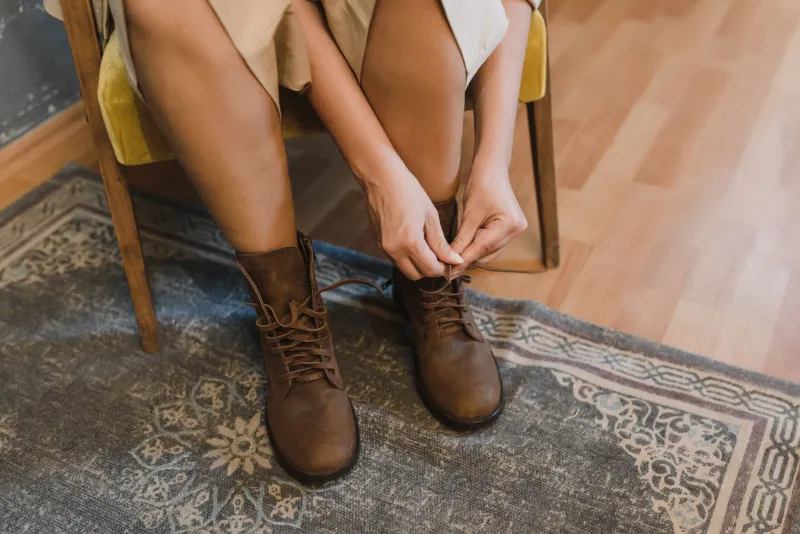
Lace-up devotees are the community's most process-oriented members. The time investment is real, and they choose it anyway. There's a meditative quality to lacing that people describe repeatedly — the repetitive motion, the progressive tightening, the way the boot gradually conforms. In desire terms, this is about the journey, not just the destination.
Buckles sit at the far end of the spectrum, and in fetish-adjacent contexts, they carry explicit associations with restraint and deliberateness. Every buckle is a decision. Multiple buckles are multiple decisions. The person who chooses a six-buckle boot over a zip-up equivalent isn't just picking a style — they're choosing an experience of intentionality that has its own particular charge.
The Pattern Is the Point
None of this is about reducing anyone to a type. The point isn't to hand you a personality quiz with boots as the subject matter. The point is that for people who feel a genuine pull toward boots — who think about them more than strictly necessary, who build collections with a kind of curated intensity — the preferences aren't random.
They're a language. And like most languages spoken fluently enough, they start to say things you didn't consciously plan to say.
Next time you're standing in a store, or scrolling through a brand's new arrivals, or reaching for a specific pair without quite knowing why — pay attention to what you're actually reaching for. The shaft height. The material. The heel. The closure. The whole picture.
You're not just picking a boot. You're telling yourself something about who you are and what you want. The question is whether you're listening.