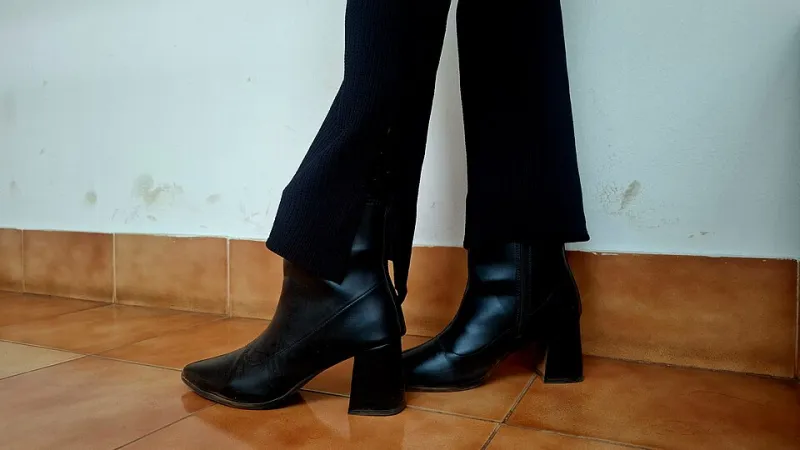
When the Boots Become the Brand: Navigating Life After Your Obsession Goes Public

Photo by Photo by Zulfugar Karimov on Unsplash on Unsplash
Somewhere between the third time a coworker says "oh, those are you" when you walk in wearing a new pair and the moment your Instagram following starts to grow because people genuinely want to see what's on your feet that day — something shifts. Your private passion has graduated into a public identity. And that, as anyone who's been through it will tell you, is a whole different experience.
For a lot of people in the boot community, this crossover happens quietly. You didn't announce anything. You didn't launch a brand or write a manifesto. You just kept showing up — to work, to dinner, to every occasion imaginable — in boots that meant something to you. And eventually, the world took notice.
So what actually happens when your obsession stops being a secret and starts being your signature?
The Tipping Point Nobody Warns You About
Ask anyone who's gone through this, and they'll usually describe the same thing: a slow accumulation of moments that eventually reach critical mass. Marcus, a 34-year-old marketing consultant based in Austin, Texas, says he didn't realize his boot enthusiasm had become a defining characteristic until a client introduced him at a meeting as "the guy with the incredible boots." Not "the brilliant strategist." Not "the guy who saved our Q3 campaign." The boots.
"At first I laughed it off," he says. "But then I started noticing how often it came up. People remembered me because of them. It was weird, but honestly? It worked in my favor more than it hurt me."
That's a common experience. Boots are distinctive in a way that most fashion choices aren't. A well-chosen pair carries authority, edge, and personality all at once. When someone commits to them fully — not as an occasional accessory but as a consistent, considered statement — other people pay attention. The obsession, once visible, becomes a kind of shorthand for who you are.
The Upside of Being Known for Something
There's a real professional and social advantage to having a clear personal aesthetic, and boot culture lends itself to that in ways that feel almost unfair. Boots signal intention. They communicate that you've thought about how you present yourself, that you're not just grabbing whatever's at the bottom of the closet. Even people who know nothing about footwear can sense the confidence that comes with wearing something you genuinely love.
Jennifer, a 41-year-old attorney in Chicago, started getting serious about her boot collection about six years ago. Today, her colleagues and clients regularly comment on her footwear, and she's found that it opens conversations she wouldn't otherwise have. "It gives people a way in," she explains. "And once they're talking to me, I can show them everything else I bring to the table. The boots are just the door."
For people with a genuine fetish edge to their interest — those who are drawn to the power, the structure, the deliberate sensuality of serious boot culture — going public also means finding your people. Community follows visibility. Once you stop hiding the thing that drives you, you start attracting others who share it.
The Complications Nobody Posts About
But let's be honest about the friction that comes with this territory, because glossing over it would be a disservice.
When your aesthetic is as specific and charged as boot culture can be, not every context is going to receive it warmly. Some workplaces are conservative. Some family environments are uncomfortable with anything that reads as expressive or unconventional. And when your boots carry a fetish dimension — when part of what draws you to them is the desire, the power dynamic, the sensory experience — navigating professional and social spaces requires real awareness.
There's also the identity compression problem. Once you're known for something, people can struggle to see you as anything else. Marcus admits that while being "the boot guy" has opened doors, it's also occasionally flattened how people perceive him. "I had to work harder to make sure people knew I was more than an aesthetic," he says. "The boots got me in the room, but I had to make sure I wasn't just furniture in it."
The key, most people in this position will tell you, is intentionality. Knowing when to let the boots speak and when to step out from behind them.
Managing the Identity Shift Without Losing the Plot
If you're at the point where your boot passion is starting to bleed into your public identity — or you're thinking about letting it — a few things are worth keeping in mind.
Own it without over-explaining it. The moment you start offering lengthy justifications for your footwear choices, you undercut the confidence that made them interesting in the first place. Wear them. Let people ask. Answer simply.
Curate what you share and where. There's a version of boot culture that's completely workplace-appropriate — clean, powerful, well-crafted footwear that conveys authority. There's another version that's more explicitly fetish-coded and belongs in spaces where that's understood and welcomed. You don't have to choose one or the other permanently, but knowing which context you're in matters.
Let the community find you. One of the genuine gifts of going public with a niche passion is that it acts as a filter. The people who get it — who respond to it, who want to talk about it — tend to be exactly the kind of people worth knowing. The ones who don't get it usually just move on. That's fine.
Protect the private core of it. Even when an obsession becomes a public identity, there's usually something at the center of it that's deeply personal. The desire, the ritual, the specific meaning it holds for you. You don't owe anyone full access to that. The boots can be the public face of something that stays yours.
The Brand You Didn't Exactly Plan
Personal branding is a term that gets thrown around a lot in professional development circles, usually in the context of LinkedIn profiles and elevator pitches. But the most powerful versions of it aren't manufactured — they're just the authentic expression of what someone genuinely cares about, made consistent and visible over time.
That's exactly what happens when a boot obsession goes public. You didn't hire a consultant. You didn't run a focus group. You just kept wearing what you loved, kept showing up fully, and let the world draw its own conclusions.
The result is a brand built on something real. And in a world full of carefully constructed personas and carefully managed impressions, that's rarer than it sounds.
Wear the boots. Let them say what they say. And then show people everything else you've got.